
Introduction
Hermes Relay curates high-impact cybersecurity news and turns it into a daily executive-ready briefing. It pulls from trusted industry RSS feeds, filters out stories you have already seen, uses Google Vertex AI Gemini to score and summarize the top items, then writes structured JSON + HTML outputs — with optional email delivery through iCloud SMTP.
Repository: github.com/r0cstar09/hermes-relay
Problem
Security teams and leaders are flooded with headlines. Manually scanning nine-plus feeds, picking what matters, writing board-level context, and formatting a briefing for email or LinkedIn does not scale — and it is easy to skip on busy days. Hermes Relay automates the collect → dedupe → rank → summarize → deliver loop so the briefing shows up consistently.
What it does
Each run follows a two-stage pipeline orchestrated by orchestrator.py:
-
hermes-relay.py— Fetches RSS entries from sources including Krebs on Security, BleepingComputer, Mandiant, Microsoft Security, Google TAG, Unit 42, CISA alerts/advisories, and Dark Reading. Hashes title + link to deduplicate against priorhermes_signal_*.jsonfiles, then saves today’s new articles tohermes_signal_YYYY-MM-DD.json. -
llm_score_and_summarize.py— Loads today’s new articles, applies a rotating “lens of the day” (e.g. first-24-hours response, supply-chain risk, explain to non-security leadership), and calls Vertex Gemini to score stories and produce:- Key takeaways and board-level impact notes
- LinkedIn-ready copy blocks
- Ranked top stories saved to
json_output/YYYY-MM-DD/hermes_llm_top3_*.json - A styled HTML briefing at
hermes_briefing_*.html - Optional SMTP email if credentials are configured
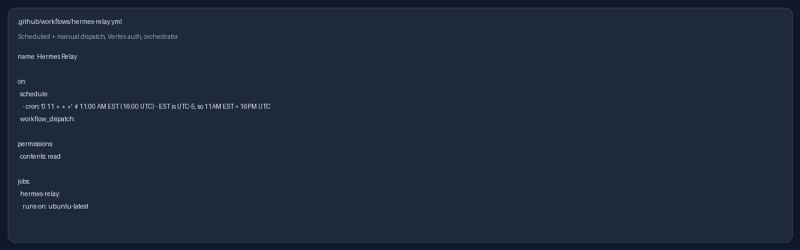
GitHub Actions runs the same pipeline on a daily cron (and manual dispatch), authenticates to GCP via a service account secret, and uploads JSON/HTML artifacts for 30 days.
How the project is structured
hermes-relay/
├── hermes-relay.py              # RSS ingest + dedupe → hermes_signal_*.json
├── llm_score_and_summarize.py     # Vertex Gemini scoring + HTML/email
├── orchestrator.py                # validates env, runs both scripts
├── hermes_signal_YYYY-MM-DD.json
├── json_output/YYYY-MM-DD/
│   ├── hermes_llm_top3_*.json
│   └── hermes_briefing_*.html
├── .github/workflows/hermes-relay.yml
└── requirements.txt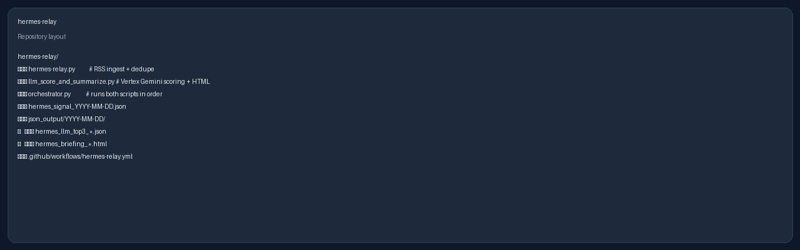
- Ingest layer — Feed list, parsing, and hash-based dedupe so only new stories enter the LLM step.
- Intelligence layer — Prompt engineering with daily lenses and per-article angle selection; Gemini returns scored summaries tuned for executives and practitioners.
- Delivery layer — HTML briefing template with article cards, scores, board notes, and copy-paste LinkedIn blocks; email is optional.
- Automation layer — Workflow validates GCP secrets, runs
orchestrator.py, uploads artifacts.
What the briefing looks like
The HTML output is designed like a morning intelligence email: briefing title, date, ranked articles with scores out of 10, bullet takeaways, yellow board-level impact sections, and blue LinkedIn-ready copy blocks.
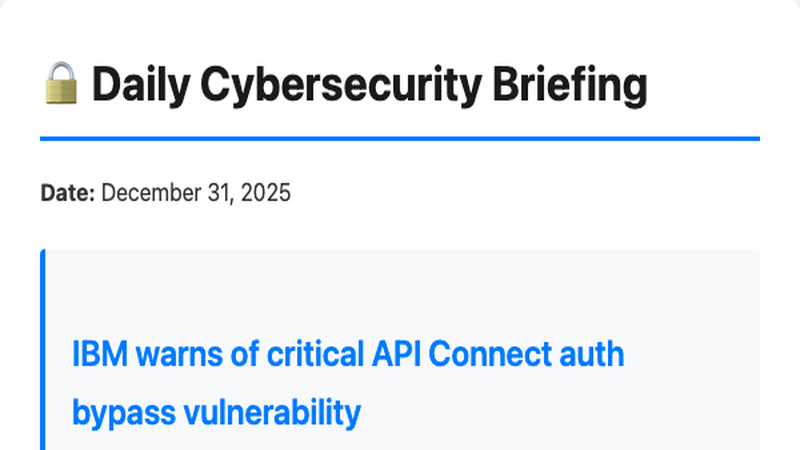
Each story links back to the original source. The lens rotates by calendar day so summaries emphasize different executive angles over time — compliance one day, concrete detections the next, threat-landscape framing another.
Stack
| Layer | Technology |
|---|---|
| Ingest | Python, feedparser, SHA-256 dedupe |
| LLM | Google Vertex AI Gemini (gemini-2.5-flash default) |
| Orchestration | orchestrator.py, GitHub Actions cron + workflow_dispatch |
| Output | JSON artifacts + styled HTML briefing |
| Email (optional) | iCloud SMTP |
Outcomes
- Consistent daily briefings without manual feed triage
- Deduped ingest so repeat headlines do not re-enter the pipeline
- Executive-ready formatting — board notes and social copy included
- Scheduled automation with artifact retention in CI
- Secrets isolated — GCP and SMTP credentials stay in GitHub Secrets / local
.env, not in the repo
Repository
Full source and workflow: github.com/r0cstar09/hermes-relay