Code-driven AI illustrations are more useful than images from dedicated image models
Code-driven AI visuals offer precise, iterative design control for new product development.
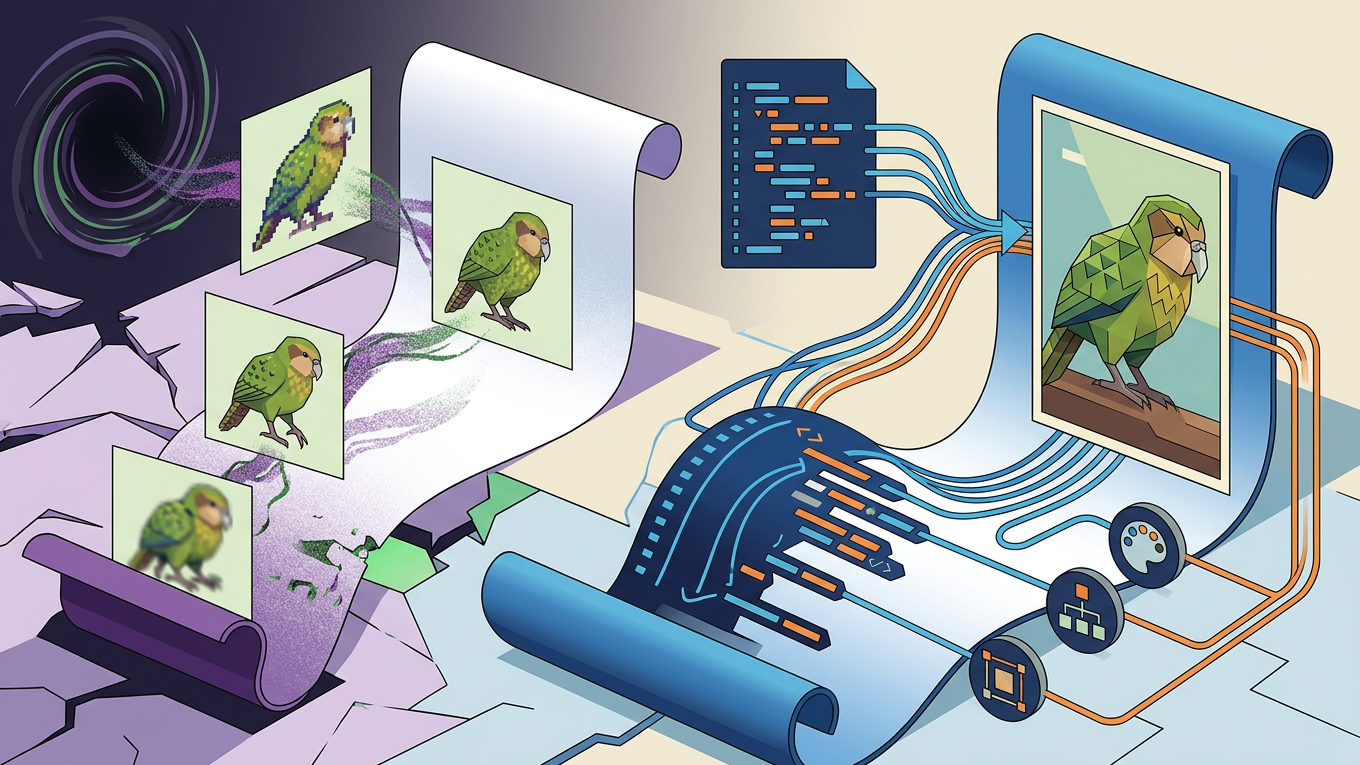
For a while, it seemed like the future of AI-generated visuals was bigger, better, more photorealistic diffusion models. But as Simon Willison pointed out in a late November 2026 post, the more useful breakthrough might be getting text-based LLMs to just write code that draws the image for you.
This isn’t about generating slightly better stock photos. It’s a fundamental shift in the output format, moving from a static grid of pixels to editable, structured code.
From Pixels to Programs
The standard text-to-image model—think DALL-E or Midjourney—gives you a flat bitmap. If the text is misspelled or a hand has seven fingers, your main option is to roll the dice on a new generation or try to describe a fix. It’s an artifact, not a component.
Willison demonstrates a different approach using a hypothetical “Gemini 4 Neon” to create an SVG poster. He asks for a design, then iterates with prompts like “make the kakapo a bit more realistic” and provides image feedback to fix text that doesn’t fit. The key is that the final output isn’t a PNG; it’s an SVG file. Every element—the text, the shapes, the colors—is defined in the code. You can open it in a text editor or a design tool like Inkscape and directly manipulate any part of it.
This extends beyond SVG. As Willison notes, models like “Claude Opus 5.5” and “GPT-6 Astra” are reportedly generating game assets by writing Blender scripts, HTML/CSS for web components, and even WebGPU shaders. The AI’s job is to produce the recipe, not the finished meal.
A More Useful, Composable Workflow
For anyone building products, this is a significant change. An AI that generates code is an AI that participates in your existing workflow. An editable SVG can be tweaked, themed, and version-controlled. A generated HTML component can be dropped into a design system. You’re not just getting an illustration; you’re getting a starting point that understands structure.
Willison argues this is why he was wrong to think Anthropic was at a disadvantage without a dedicated image model to compete with Google’s and OpenAI’s. It turns out a sufficiently capable text model can sidestep the problem by treating visual design as a coding challenge. This is a great example of the “bitter lesson” in practice: general-purpose computation, scaled up, often subsumes specialized approaches.
Of course, when an AI starts handing you code instead of a simple image, the security considerations change. An SVG file can contain JavaScript. If you’re building a service that allows users to generate and display these code-driven assets, you’re not just hosting images anymore. You’re rendering code that an LLM wrote.
This doesn’t negate the utility, but it does mean our validation and sanitization pipelines need to keep pace. If your AI pipeline now generates code instead of just pixels, is your security review process ready to tell the difference between a benign SVG and one that’s about to cause problems?
Source: Code-driven AI illustrations are more useful than images from dedicated image models